
 photo credit: California State Parks
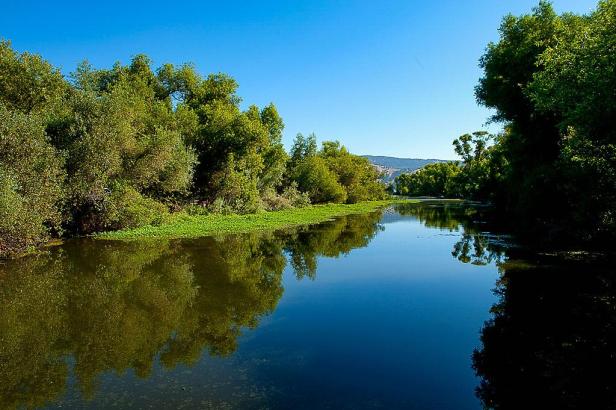
Still water on Clear Lake mirrors the trees and ridgeline above.
Clear Lake recently finished a major test of a new phosphorus‑removal technology, part of a state‑funded effort to slow the harmful algal blooms that have intensified with drought and warming temperatures.
The pilot project is meant to understand whether reducing nutrient release from the lakebed can improve water quality and results could have much broader implications across the state.
KRCB's Shandra Back spoke with Lake County News Editor and Publisher Elizabeth Larson about why this lake is drawing so much scientific attention.
KRCB NEWS: Clear Lake has become a big focus for research and restoration work. Why is that?
ELIZABETH LARSON: Well, it's believed to be the oldest freshwater lake in North America, up to 2.5 million years old. It's a pretty incredible lake. It's the largest freshwater lake entirely within the state of California. And at that age, it's got a lot to teach us.
We've always been a center of scientific research, but in 2017, Assemblymember Cecilia Aguiar-Curry authored Assembly Bill 707, and that bill created the Blue Ribbon Committee for the Rehabilitation of Clear Lake.
And so it's that committee that is now overseeing and vetting and approving projects like the phosphorus loading demonstration project to address phosphorus loading. That's what it's meant to do.
KRCB: When we say the rehabilitation of Clear Lake, why do we need to think about rehabilitating Clear Lake?
LARSON: One of the key reasons, in addition to supporting an amazing ecosystem, is that it affects so many other things. About 60% of Lake County's residents depend on it as a drinking water source.
So it's critical to all manner of life in Lake County. It's also considered one of the best bass fishing lakes in all of North America. So it's a business incubator all on its own as well.
KRCB: Can you talk a little bit about climate change and historical factors that have led us to a point where we're thinking about really needing to rehabilitate Clear Lake and put investment into this project?
LARSON: Around 2008 or 2009, when we started really hitting some pretty serious drought years again, the lake was very, very low, and we were seeing a lot of what are called harmful algal blooms, or cyanobacteria.
And harmful algal blooms are a problem nationwide and worldwide. They are believed to be a pretty good indicator of climate change due to changes in heat, and they can cause harm. They can kill wildlife, they can make people sick, they can do all sorts of things if you come in contact with them or ingest them. And one of the things that seems to cause them is nutrient loading.
Things like too much nitrogen or too much phosphorus in a water body will just feed those blooms, and away they go. And then you have things like fish die-offs and all sorts of things. So it has a ripple effect. Since we're talking about water, it has a larger ripple effect across the ecosystem and across quality of life.
KRCB: Can you briefly explain what these tests are for our listeners?
LARSON: So a company called EutroPHIX carried out this project. They used a product called EutroSORB G. They take a slurry of this product, and they took it out on boats, and they put it on the surface of the water.
It will settle to the bottom, and it will cover the sediment and bind it, and it will stay there permanently. They have insisted that it is harmless. It will not harm fish. It will not harm people. But it will bind the sediment and prevent the release of phosphorus out of the sediment, which in turn, of course, feeds the harmful algal blooms.
KRCB: So Elizabeth, you're located in Lake County, and we're talking about Clear Lake right now. What does this lake mean and represent?
LARSON: I think it certainly means different things to different people. I think to the Native peoples here, it's a center of life. It's something that gave them sustenance and that they have a spiritual connection to. I think for others, a lot of the rest of us too also have a deep connection to it. It's a beautiful lake. The scenery here is amazing. There are people who subsistence fish here.
There are people who make their living here, whether it's tourism-related or fishing or anything like that. And with that, it brings its own concerns and ways of living. I mean, you have to be mindful of it.
You have to be respectful of it. But I think in the times I've written about the lake, when there have been public meetings about the lake, I've seen standing-room-only meetings where people come to want to hear about the lake because they care about it so much. They really do love it. People have some pretty harsh opinions about it sometimes, but ultimately I think that is an outgrowth of concern. It matters to people. They want it to be healthy.
KRCB: And what would success look like if these tests are successful?
LARSON: Well, from the scientific aspect, again, you'd have to speak to a scientist, but I think what they're looking for is water quality. They're looking at whether the phosphorus is releasing. I think the hope is that we will see those levels in some areas that are traditionally at a certain baseline start to go down and start to improve.
KRCB: And if that starts to improve, how do you think that would affect the residents of Lake County? What would change look like?
LARSON: On the recreational side, I think it would be a way of promoting the lake, saying, look at this positive. And also scientifically, if this works here, this could offer promises for other lakes around the country. There are other lakes where this same treatment that was just done is going to be rolled out. So I think it offers a lot of potential benefits. I'm not sure that everybody in their day-to-day lives will necessarily think about it, but it would certainly raise the profile of Lake County in a very positive way if this project is successful.
KRCB: So what's next? What are you following in your ongoing coverage?
LARSON: We'll be watching with interest the ongoing sampling that is a part of this project. It's not one and done. It's going to continue. And EutroPHIX has said that what they anticipate happening is creating one of the largest data sets for Clear Lake that's ever been assembled. So I'm really interested to see how it works. You go from theory and from some practice to actual application. Let's see what happens. And then seeing what other projects get done and the results, and what the long-term implications truly could be.
KRCB: Is there anything that I've missed about the importance of these conversations, these testings, and what it means for the community of Lake County?
LARSON: I'm glad to see that Lake County is getting investment like this. We are a very economically challenged area, and because of the lake's importance to our economy, having this kind of help and interest is important. And of course, it has wider-ranging implications, not just for us, but for water quality worldwide. Water quality is central to human life. Water sources are central to human life, so taking good care of our water is pretty critical.
Read Elizabeth Larson's full story here.

 NPR
NPR Spotify