

 photo credit: Shandra Back
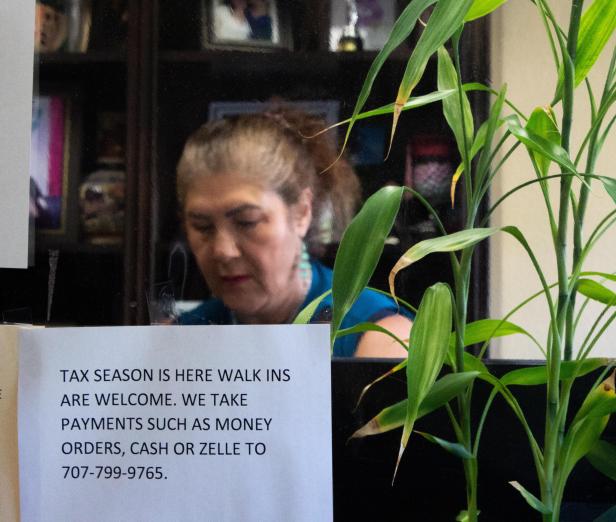
Martha Valencia works inside her Santa Rosa tax shop, where signs remind clients that tax season is underway and outline how to pay for services.
But this year has been slower than normal.
The bell is usually ringing off the hook, says Valencia, with lines out the door.
She and her son fit walk-ins between appointments, trying to keep wait times under an hour. But today, “it’s empty,” Valencia says. “They have to wait nothing.”
Valencia, who has been doing immigration and tax services for over twenty years, says around 80 percent of her clients file with an ITIN, the tax number used by people, like undocumented immigrants, who don’t qualify for a Social Security number.
This year, though, business isn’t just slow, it’s the worst she’s ever seen.
Valencia says she’s seeing a 60 percent drop in clients.
“Not even in the pandemic I had a drop like this,” she says.
Valencia believes the drop is linked to larger governmental changes.
This year, HR1, also known as the “One Big Beautiful Bill Act” is tightening restrictions on ITIN filers.
One of the biggest changes for undocumented taxpayers is much smaller refunds, says Valencia.
One of the most notable, she says, is the Additional Child Tax Credit, which previously allowed many mixed‑status families to receive thousands of dollars back.
Many of Valencia’s clients are long-term customers. The tax business is built on trust, she says. This year, before accepting any work, Valencia feels an ethical obligation to tell clients the bad news, that their refunds will be smaller, and maybe nonexistent. Vigil says a mixed-status household could expect to receive around $2,000 in the Additional Child Tax Credit. But this year, they’re lucky to get $500, she says.
Valencia says the reaction this year has been immediate. She says they tell her: “You know what? I’m not going to file because I’m not getting any refund. So what’s the point of doing taxes?”
For an undocumented immigrant, having proof of taxes is important. It builds a paper trail, so if the day comes to receive legal status, it shows work history, engagement with the system and U.S. presence.
But, Valencia says, customers are coming in worn-down, without a vision for future immigration relief. They tell her their faith in the system is dropping.
Claudia, an undocumented immigrant from Mexico, sits wringing her hands in her lap. The mother of two has been living in California for over 20 years and says she’s done her taxes every year and pays into the system in many ways.
“You pay taxes on what you earn, on what you buy, on everything you consume in this country,” Claudia says. “But you can’t get anything back from it.”
Claudia is a day laborer and files taxes in the hope that one day she’ll receive documentation to be able to visit her family in Mexico, find work more easily and live without fear of life without status.
“You hold onto the hope that, in the future, you’ll be able to do things the right way,” Claudia says.
But after over twenty years of filing, her hope towards legalization only seems to be dwindling. “In the end, there’s nothing there for you, is there?” she says.
Claudia still sees no pathway to legal status and receives no social security benefits, no MediCal, and this year for the first time, she was told she’ll receive no credits back for her son, who is a U.S. citizen.
Her voice grows soft. “So, what’s the point in paying?” Claudia asks. “There’s no hope for someone like me.”
Claudia went back and forth in her head deciding if this would be the year she broke her commitment to a stable future here. In the end, she filed, but her doubt continues to grow, both in the system and her future in the United States.
In the Southern California city of Pomona, tax preparer Hayde Vigil says her business is also seeing about half its usual filings this year.
Yet the steep drop looks different in Southern California, she explains. Most of her clients are documented, Vigil explains, but status doesn’t seem to be the issue.
“They’re afraid to leave their homes because there are so many raids, and they’re scared they’ll be detained and deported,” Vigil says.
Immigration enforcement agents have been active in that region, and her customers are afraid they’ll be picked up because they're Latino even if they are here legally.
“They weren’t going out at all before, and now they only go out for the bare minimum,” says Vigil, which doesn’t seem to include leaving the house to file taxes this year.
It’s a common belief that immigrants don’t pay taxes, says Abby Raisz, Vice President of Research at the Bay Area Council Economic Institute. But it’s not true.
“Undocumented immigrants maintain very high effective tax rates,” Raisz says — averaging 7.1% in state and local taxes, higher than the rate paid by the top 1% of earners nationally.
Her team estimates undocumented Californians contribute about 9% of the state’s GDP, roughly $278 billion, a figure on the order of the entire GDP of Nevada or Oregon.
They also pay more than $10.6 billion in state and local taxes and another $13 billion in federal taxes, despite being excluded from most federal benefits.
Josh Stehlik, Policy Director for the California Immigrant Policy Center, says those contributions are essential to the state’s fiscal health.
“Undocumented taxpayers are extremely important to the national economy and to California’s economy,” Stehlik says.
A recent analysis by the California Budget Center and the Institute on Taxation and Economic Policy (ITEP) found that undocumented workers generate nearly 5% of California’s GDP and paid about $8.5 billion in state and local taxes in 2022.
But both experts say trust in the tax system is quickly eroding.
Last year, the IRS was directed by the Trump administration to enter negotiations with the Department of Homeland Security over sharing taxpayer information with immigration authorities, a move immigrant‑rights groups called unprecedented.
Federal courts have since blocked the IRS‑DHS data‑sharing agreement, but the episode has already shaken confidence in the system.
Raisz says, after speaking with other tax preparers in the state, the implications for an already fragile trust could be long‑lasting.
“If this taxpayer information does in fact get related to other departments, ITIN is going to lose all of the trust that it currently has,” Raisz says, and warned tax preparers shared they probably won’t ever gain it back.
Stehlik says new federal policy changes have only deepened the fear.
“Immigrant taxpayers are afraid to file because of the Trump administration’s repeated attacks on immigrant taxpayer confidentiality,” Stehlik says.
Experts warn that if undocumented immigrants disengage from the tax system, the consequences would be severe.
“We could be looking at an $8.5 billion loss in revenue,” Stehlik says, referencing the ITEP‑based figure for undocumented Californians’ state and local tax contributions in 2022.
Raisz agrees the long‑term implications would be enormous.
Undocumented immigrants contribute billions in sales tax revenue, and their consumer spending powers local businesses already struggling with post‑pandemic declines.
“The larger concern seems to be the loss of trust and disengagement from the tax system,” Raisz says.
She adds that undocumented taxpayers are often economically engaged, starting businesses, buying homes, and supporting local economies.
If they continue to disengage, she says, the economic fallout “would be massive.”

 NPR
NPR Spotify