
 photo credit: Tina Caputo
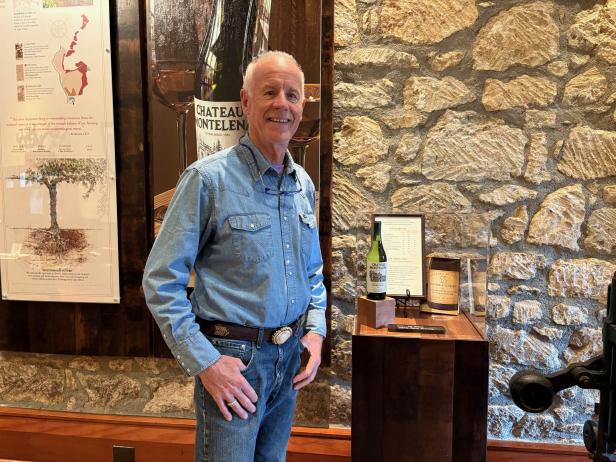
Bo Barrett with the winning bottle of 1973 Chateau Montelena Chardonnay.
May 24 marks the 50-year anniversary of the famous “Judgment of Paris tasting, when a panel of French wine judges ranked two California wines—the 1973 Chateau Montelena Chardonnay and 1973 Stag’s Leap Wine Cellars Cabernet Sauvignon—as the winners in a blind taste-off against the best wines from France.
The results shocked the wine world. It was such a big moment in California’s wine history that it inspired a book, a movie, an opera—and even a rap song.
But according to John Skupny, the Judgment of Paris was just one of the factors that led to Napa Valley’s rise to stardom. Skupny owns Lang & Reed winery in St. Helena and teaches a class about the region’s agricultural history.
“To me, eventually,” Skupny said, “it became part of the trifecta of what made California valid.”
First in the trifecta, he noted, was the opening of Robert Mondavi winery in 1966. Then, in 1968, Napa Valley enacted the nation’s first agricultural preserve to prevent over-development.
“The Paris tasting in ‘76 was just icing on the cake,” Skupny said. “It really solidified it. The world had to start looking.”
For Chateau Montelena, maker of the winning Chardonnay, the impact was immediate.
Bo Barrett, the winery’s owner, said North Coast wines were already starting to be recognized in San Francisco and Los Angeles in 1976. But in the rest of the country? Not so much. The Paris tasting changed that.
“The primary result was the people who had said, ‘We don't carry California wines’ the week before, were suddenly calling us to try to buy some wine,” Barrett said. “And so whether it's Boston, New York, D.C.—the rest of the country overnight recognized what the West Coast had been seeing… that really high-quality wines were being produced in California.”
Barrett said the tasting didn’t just show the world that great wines could be made outside of Europe. It also helped heal the damage caused by Prohibition.
“Prohibition basically taught three generations of Americans to drink spirits and beer,” he explained, “because you can make beer anywhere and you can boil the beer anywhere, but the vineyards were so easy for the government to shut down. So, the crushing of the American wine industry was the result of Prohibition.”
Without the Paris tasting, he said, it would have taken a lot longer for the U.S. wine industry to recover.
“The Paris tasting basically skipped us a generation,” Barrett said. “So instead of 60 years for Prohibition to go away, it would've been a hundred absent the Paris tasting.”
50 years after California’s epic showdown with France, Barrett said he believes California wine still has something to prove to the rest of the world.
“I think the Paris tasting set a very high bar for Napa Valley and American wine producers,” he said, “and I think jumping over that bar is still important.”
Patrick Cappiello of Monte Rio Cellars in Sebastopol said he agrees. Last month, he staged a modern reboot of the Paris tasting with New York wine professionals as judges.
With the American wine industry in a serious downturn, Cappiello said he’s hoping to create a new Judgment of Paris moment.
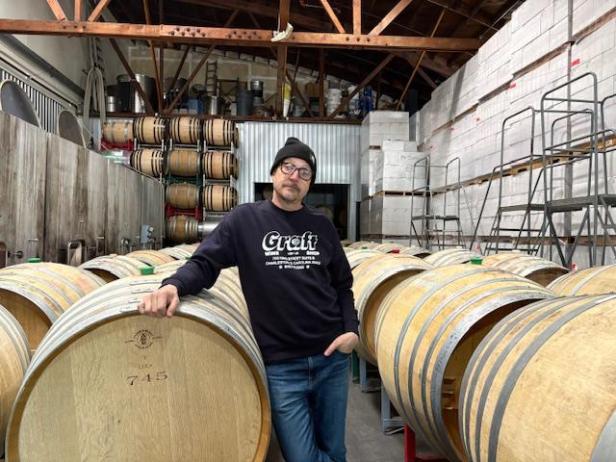 photo credit: Tina Caputo
Patrick Cappiello of Monte Rio Cellars
“I get the Wine Business [Monthly]—the press roundup—every morning when I wake up,” Cappiello said. “It's the worst thing to wake up to because it's just so much terrible news. I mean, there's not anything being written about right now except for all the shit that's happening bad.”
Though he acknowledges he was among the first winemakers to call out the struggles of small wineries, Cappiello is now looking to put out a more upbeat message.
“Even though maybe I was the first one being really negative about what was going on,” he said, “I'd like to flip the script and be somebody who's got something more positive to say.”
Cappiello said one of his main motivations for creating what he calls the ’76 Redo was showing his former colleagues in the New York sommelier community—and American consumers—that U.S. wines can be just as exciting as those from Europe.
“That's the thing about the United States is it's a wine culture that was so heavily founded on the European wine culture,” Cappiello said. “And I think that U.S. wineries have always struggled to find their place in their own country and in wine culture in general, because people have this belief that European wines are of higher quality, are better.”
Like the original Paris tasting, Cappiello’s reboot challenged that idea.
The results were mixed.
This time, a French wine took the title of best Cabernet Sauvignon, and California wines ranked first in the new Chenin Blanc and Syrah categories. The winning Chardonnay wasn’t from France or California. It came from Oregon’s Willamette Valley.
A lot has changed since 1976.

 NPR
NPR Spotify