

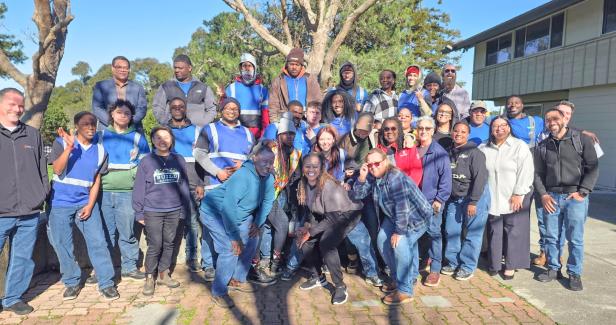
 photo credit: Kaleb Carpenter
Graduates from Marin City’s first pre-apprenticeship trades program meet with potential employers for mock
interviews at a contractors showcase on Jan. 8, 2026 in Marin City.
The first class of 21 students — ranging from young adults to older residents — graduated in January from the pre-apprenticeship construction trades program, and organizers hope to launch a second class this spring if funding comes through.
Beginning in May, construction crews will move through the first buildings of a massive multi-year renovation of Marin County’s largest public housing project. They will strip out the interiors of 83 units, floor-by-floor, repair masonry, upgrade electrical wiring, plumbing, carpentry and appliances, and finish with fresh paint before residents return. The job will require a lot of skilled trades workers.
The intensive, hands-on construction course is designed to prepare high school graduates of any age for union apprenticeships and jobs on major building projects — including the planned renovation of Golden Gate Village.
Major building projects are nothing new to the program’s director Juanita Douglas, executive director of Tradeswomen Inc., a statewide nonprofit that works to open building career pathways to women and underserved communities.
Douglas began as a carpenter over 40 years ago and worked her way up to head surveyor for major building and infrastructure projects in the Bay Area, including the San Francisco MUNI Third Street Light Rail and the China Basin redevelopment.
For nearly three months, the students in the pre-apprenticeship program spent long days in both classroom instruction and hands-on training. They learned to use power tools, install drywall, perform plumbing work and understand electrical systems while also earning OSHA 10-Hour safety certification and CPR training. Beyond technical skills, the program emphasized financial literacy, physical and mental fitness, drug testing and job readiness.
The renovation of Golden Gate Village will be done by Nibbi Brothers General Contractors, as well as 40 subcontracting companies.
“I have a young lady taking the surveyor’s test this Friday in Sacramento, and if she passes, she’s got the job,” said Douglas. “We have one person interviewed and sponsored by Nibbi,” she said, “He will need 200 more hours of hands-on training to enter the carpenter’s union, and we are working on getting that.”
That extra training can be received on the job or through trade unions, like the North Coast States Carpenters Union.The next step on the students career path is professional apprenticeships, which can take four to five years to complete and cost tens of thousands of dollars in training investment by unions and employers.
“The only thing we do is prepare them mentally and physically,” Douglas said. “They have to convince these contractors and unions that they’re worth taking up. It costs $90,000 to $95,000 to train them in an apprenticeship.”
All apprenticeship candidates must have a high school diploma and a driver’s license, but the Marin City graduates are mostly dependent on public transit.
“The biggest issue is transportation,” said Douglas. “They just don’t have it. If they can get a job and they can keep it up to six months, they’re going to make enough money to buy a car.”
Douglas’ professional network has enabled her to connect the graduates with potential employers. She even bused them to participate in a mock interview event in San Jose.
The Golden Gate Village renovation will be an opportunity to establish a local working relationship with the historically underserved Black community that has lived in Marin City since World War II. Thousands of Black workers migrated to the area in the 1940s for good paying jobs in the Bay Area’s federal shipyards, including Marin City. After the war, white workers moved elsewhere to buy homes and start families, while the Black workers were restricted from moving through discriminatory real estate practices like redlining.
There is another big building project currently underway in Marin City, by the developer Pacific Companies, which the community opposed. The Drake Avenue Apartments, according to Douglas, has not hired workers from the neighborhood.
“I don’t see that happening at all,” she said. “No one from the neighborhood worked there during the build, and they had no interaction with this community.”
For many participants, the program represents more than job training. It is a chance to gain financial stability and break cycles of poverty in a community where opportunities can be limited.
Golden Gate Village resident Kim Robinson is a single mother of six who went through the program with her three adult sons and nephew. She enrolled while searching for a career that could support her family long-term.
“Before the tradeswomen began, I was kind of in a hole of figuring out what I could do — like a career that I can do that can sustain not only me and my kids, but I can build on and retire from potentially,” Robinson said.
Robinson said she loved the discipline of the course and the opportunity for personal growth.
“If you’re on time, you’re late,” she said, repeating the first lesson delivered by Douglas in the course. “I had never heard that phrase before. I’ve been using that line ever since.”
Students also renovated two Golden Gate Village housing units during the program, stripping them down to their structural elements. They removed tubs, toilets and cabinets before doing plumbing, electrical and carpentry repairs. The experience gave students practical skills they could immediately apply at home.
“My sink was slow to drain — my son got up under there, took the pipes off, drained them out and redid it,” she said. “He learned that in this program.”
Robinson hopes to eventually work in industrial painting and one day become a building inspector.
But her immediate dream is simpler: helping build homes in the neighborhood where she lives.
“If you don’t let me do it, let one of my boys do it,” Robinson said. “It would just be nice for somebody in the community to know, like, I work on this. I live here.”
Douglas said they need to raise $300,000 to run another class to pay for the instructors, supplies and uniforms.
The workforce training program comes at an opportune time. California Department of Housing and Community Development has set a goal to plan for 2.5 million new housing units by the start of 2031. According to the jobs website ZipRecruiter.com, a plumber in California makes an average annual income of $62,300.
“I was able to send my son to college with no student loans,” said Douglas. “I want every last one of them to be able to do that. These young people are in a vicious cycle. So many kids in these three and four-bedroom homes, with a great grandmother, grandmother, a mother, their parents, and they got three kids. We are in America. It’s capitalism. We need money to survive.”
A short documentary about the Golden Gate Program can be viewed at www.youtube.com/watch?v=rKWro9A51Kw

 NPR
NPR Spotify