

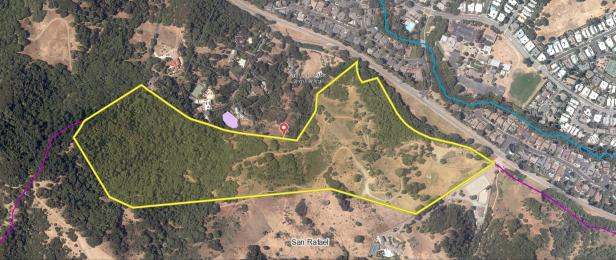
 photo credit: Courtesy of County of Marin
A map of the 61-acre site at 1501 Lucas Valley Road in unincorporated San Rafael.
The developer, emboldened by recent state laws to streamline housing permits, argues that county staff are unlawfully causing unnecessary costs and delays to the project at 1501 Lucas Valley Road.
At a Monday meeting, community speakers raised concerns about the impacts of the project on public safety, citing single-road access as a hazard in fire evacuations and excessive grading as creating a potential risk for localized flooding. The commissioners concurred and proceeded to require further environmental review.
The developer's representative, Steve Reilly of the 330 Land Company in Danville, left the meeting early.
"I am concerned that the applicant's representative was not interested in hearing anyone's comments, and I think that it's pretty clear that they plan to litigate," said commissioner Leila Monroe.
The Souang 61.3-acre subdivision will entail the construction of 36 new, single-family, dwellings set in rows on a single flat foundation dug into a hillside. Fifteen of the homes will include optional junior accessory dwelling units, like a single apartment, attached to the home. Thirty-one homes will be market-rate, while five will be deed-restricted below-market rate -- three for very low-income and two for low-income households, or 50% and 80% of area median income.
The houses will be built one way or another.
In May, the development was permitted ministerially through a Housing Compliance Report, a streamlined process set in place by the state's 2019 Housing Accountability Act. Ministerial approval means a project must be automatically permitted when it meets housing element standards and lies within areas designated by the local government's inventory of potential locations for future housing.
The housing permit is exempt from an environmental impact report under the California Environmental Quality Act, according to Marin County planners.
There was an EIR done for the site during the housing element process, but that was before anyone saw the specific plans for the Souang subdivision.
"Which is why now this is a project for the purposes of the California Environmental Quality Act," said the project's principal planner Immanuel Bereket.
The county picked Sicular Environmental Consulting to do the environmental review and notified the developer Oct. 17 that they will be charged the full cost of the review, as well as the county's 30% administrative overhead.
In a Nov. 24 letter, the developer's law firm Miller Starr Regalia accuses the county of forcing their own consultant on the developer. They allege the scope of the environmental review is too big and costly for the project, and the county is improperly assuming that the 51.6 acres on the parcel that will not contain homes would be designated as private open space.
"County has proceeded in a course of conduct undertaken for an improper purpose -- to harass, to cause unnecessary delay, and add excessive and unnecessary cost to the Project -- in a manner that violates state housing law," the letter read. "If continued, the county's conduct would expose the count to costly litigation that it would no doubt lose."
In Monday's meeting, commission chair Gregory Stepanicich noted that in the two options presented in the plan, his biggest problem was the site's grading. Option 1 featured a 15-foot retaining wall, and option 2 featured a stepped wall solution but required the removal of almost 130,000 cubic yards of soil.
"I couldn't figure out why there were straight streets on a very hilly property," said Stepanicich, recalling the flat-pad developments of the 1970s that resulted in landslides in Los Angeles. "In the entire Lucas Valley, there were developments that took a lot of grading, but it was conformed to the topography, and that is what is concerning to me in this project. It doesn't do that. The developer has taken exception to that."
Stepanicich said the developer could have chosen to substantially conform to the county's code, in which the grading requirements are based on the land form. The roads should follow the slope of the land with each house having its own pad, he said, rather than one large flat pad, and there should be more than one way in and one way out.
"We would be done with this project at this point in time," he said. "The only reason we're having this discussion is because there have been so many exceptions and waivers taken from some really essential requirements."
"It's either a horrible, awful, ugly retaining wall or a hundred thousand yards of off-haul," said commissioner Margot Biehle. "Either of which is just horrible. There's got to be a better way to deal with this."
The planning commission denied the appeal and confirmed that the developer must fund an environmental review, offering to solicit alternative bids for another consultant. If the developer refuses, the commission said, it must abandon the Vesting Tentative Map and Tree Removal Permit applications. Their action has no effect on the approved housing component of the project.

 NPR
NPR Spotify